


Representations of life in the penal settlement at Sydney Cove
Australian newspaper accounts of early Sydney Cove
Later Australian newspaper accounts provide a retrospective picture of life in the early penal settlement, drawing on First Fleet records, historical research and stories that may have survived through families and community memory. Although they are not themselves contemporary First Fleet accounts, they add descriptive detail about everyday life and help connect the original settlement with landmarks familiar to later generations.
Sources: See hyperlinked headings
Source type: Primary / secondary
KEY TOPICS COVERED
-
Establishing Sydney Cove
-
Layout and development of early Sydney
-
Food shortages and survival
-
Convict life, crime and punishment
-
Alcohol, gambling and social problems
-
Different representations of the early colony
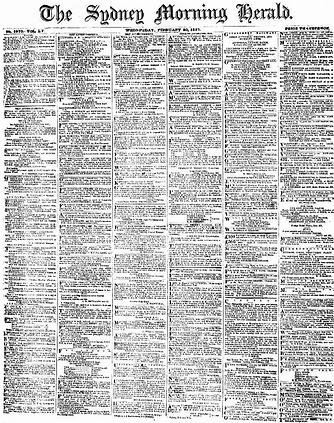
Victorian-era newspaper excerpts have been included as they fall within the living memory of the first and second generations of First Fleet convicts. While most convicts did not record their experiences in writing, it is likely that their stories were shared with family members and passed down through oral history. As a result, many of these later accounts may still retain elements grounded in lived experience and collective memory.
These newspaper articles also provide valuable texture that is largely absent from the First Fleet diaries and journals, which were predominantly written by government officials and officers. Victorian-era writers often included descriptive detail, local knowledge, and narrative interpretation that help illuminate aspects of daily life, community development, and social conditions not always captured in official records.
In addition, these articles offer important geographical context. They frequently reference landmarks that were still within living memory of the First Fleet period, but which have since been altered or replaced by later development, such as Sydney Town Hall and other significant civic structures. These references assist in understanding how early Sydney evolved and help connect historical accounts to modern landscapes.
25 Jan 1904 - THE FIRST FLEET. - Trove
THE FIRST FLEET
...(Unsuccessful at Botany Bay) ... Phillip directed that a pinnace should be sent north to explore the coast. This was done, the party being under command of a master's mate named Jackson. It was after this person that the harbor on the shores of which Sydney now stands was named.
The boat party speedily returned with a report of an ideal harbor, and a splendid site for the settlement. On the morning of the 24th the fleet weighed anchor and presently sailed into the inlet-casting anchor in the cove at the head of which the Botanic Gardens are now situated. It was a beautiful day. The scene was exquisite : the wooded hills, the broad expanse of water, the long vista of foliaged shores, islands, bays, and promontaries, and beyond the dim blue outlines of a range of mountains.
Phillip, who had a sense of poetry, must have felt his spirits rise as he contemplated this harmonious scene... The following day Phillip landed at a point, where a flagstaff had been erected.
And here the British ensign was hoisted by a sergeant of marines, named Dawes. The point to this day is called Dawes Point. Phillip addressed those around him, and proclaimed the colony in the name of His Majesty George III. A salute was fired, the marines played the National Anthem, and the foundation of the settlement was an
accomplished fact.
At once huts were erected for the accommodation of the adventurers, bond and free. Along the side of a wooded rise-at this day known as Gallows Hill, and reaching as far back as the present Cumberland street – a line of huts was erected, in which the convicts were lodged. At each end a party of marines was placed; while further back a primitive barracks was built, in which the main body of the military was accommodated.
The Governor and his principal officers had habitations built for them on the other side of the Tank Stream - a rivulet which meandered from a spring in the rising round on which the Town Hall and the Anglican Cathedral now stand, and passing down what is now Pitt street, emptied itself into the waters of the harbor, where Circular Quay is at present built.
And about this spot the site is now occupied by the old Commissariat Stores - a strong wooden building was set up, in which the stores brought out for the support of the settlement were deposited. This building was strongly guarded: for within it was the very existence of the colony. Until food supplies were locally produced the settlers would have to depend for their sustenance upon England.
The Governor found a faithful counsellor and honest supporter in Colonel Collins, who commanded the marines sent out to guard and control the prisoners of the first fleet.
Collins was a man of bluff manners, but his integrity was unimpeachable. He was also of sound sense-a keen observer and just critic. He had some pretensions to literature - had written some papers upon professional subjects and is remembered even now as the author of a quaint, old fashioned, but fairly accurate history of the settlement. This gentleman did not perhaps understand or appreciate the sentimental side of Phillip's character. But he recognised the Governor's honesty of purpose and sympathised with the difficulties of his position. Like a loyal comrade he did all in his power to help Phillip; who, indeed, needed such support, surrounded as he was by a gang of officials who, to habits of the coarsest and most degraded kind, united a greed of gain which stopped at no action that right enable them to satisfy it.
Many of these worthies traflicked in spirits and tobacco, as well as provisions. Two officers attached to the settlement joined together to purchase a cargo of ruin, which was brought to the settlement by an American schooner. The Governor interfered. He was defied. The rum was landed and sold to all who had money, or who could offer anything of value to the traders. And the settlement was drunk for a fortnight. Numerous offences were committed by persons under the influence of liquor; and five unfortunates were hanged on the gallows tree near the Tank stream; while twice as many were flogged by the government flagellators, Rice and Bullivant.
Meanwhile, starvation threatened the settlement. It became necessary to place the unfortunate convicts upon half rations.
And so scarce became flour that when an official invited anybody to dine with him stipulated that the guest should bring his own bread. As yet no wheat or corn of any kind had been produced. The first sowings were failures -the season was exceptionally dry, and those who had undertaken the business, were ignorant of the ordinary elements of agriculture. In this strait an edict was put forth, making it a capital offence to steal flour or bread. One of the first victims of this ordinance was a man named Brady, who was detected stealing bread from the Governor's kitchen.
He was hanged a few hours thereafter.
21 Feb 1867 - THE FIRST FLEET. - Trove
"...CONDITION OF THE COLONY UNDER THE FIRST GOVERNOR
The solicitude of Phillip was displayed in every form of kindness but the proneness of his people to intemperance, defeated all his efforts: he gave them stock, and had scarcely left the land, when his gifts were sold for rum. His successor was not more successful, when he tried the same plan. Cargoes of American spirit produced the madness of intoxication, and the freed settlers neglected their farms, or anticipated their produce to obtain the liquid destruction.
Their passion for gaming was universal: they sometimes staked not only their money and their goods, but even their clothing, and were seen to labour in the field, as free from clothing as the savages who surrounded them.
In spite of the dread of famine, they consumed their time and substance in intemperance: sold their seed, lent to insure their harvest. In the distribution of stores, robberies were daily committed; double rations were issued and Collins ingcnuously confesses that office converted the most trusty into thieves and that peculations were forgiven, because a change of agency was useless. All in superior circumstance-unprotected by military vigilance, were robbed and robbed again...
Those who obtained their freedom, were a source of iinfinite annoyance: unable to depart from the country, they refused all kinds of labour , and joined with others equally worthless, astonished the officers by the vigour and ingenuity of their spoliations
The account given by Collins, is a valuable delineation of society when set free from moral influence, and proves how little simple coercion can check a general disposition to crime. So rare was reformation, that a single instance is mentioned with triumph: among the few who redeemed that settlement from utter dishonour, was George Barrington, celebrated for his dexterity as a pickpocket, and for his pathos at the bar; who robbed a prince with a grace of a courtier, and was the beau ideal of swindlers. He was distinguished in New South Wales for his integrity in
the Office of chief constable, und his diligence as a farmer. He died regretted...
21 Jan 1871 - CHRONOLOGY OF THE MOST REMARKABLE OCCURRENCES OF THE COLONY. - Trove
1770.- That part of the coast of New Holland which now
constitutes the colony of New South Wales, was explored by
that able and ever-to-be-lamented navigator, Captain Cook,
accompanied by the late Sir Joseph Banks, Bart., and other
gentlemen of science.
1788.- The first fleet, under command of Captain Arthur
Phillip, anchored at Botany Bay, January 20.-French ships
Astrolabe and Buffole. Messrs. De La Peyrouse and De l'Angle,
commanders, anchored in Botany Bay, January 28.- Colony
taken possession of, and British colors displayed, by Governor
Phillip, January 28.- Norfolk Island established as a depen-
dency of these colonies, February 13, under Lieutenant King,
afterwards Captain King, and Governor of these colonies.
Shock of an earthquake, June 22, at eleven in the forenoon, the
earth teeming with a sulphurous smell for a long time after the
undulation had ceased.
1789.- A severe hurricane happened at Norfolk Island, which
did considerable damage, February 26.- A contagious disorder,
which had a near resemblance to the small-pox, the pustules
rising to an unaccountable size, visited the natives of this
colony, and many died under the distemper, April.
1789. - Bennelong, a young native, was taken prisoner, No-
vember 25, and treated with the most hospitable kindness by
Governor Phillip. He tried several times to escape, but being
always disappointed in the attempt, became afterwards so con-
genial to the authority which held him only in reserve, he was
taken to England ; and upon his return hither assumed to him-
self the character of a chief. He was naturally barbarous in
his manners ; and to him is imputed the murder of one of his
wives and one or two of his children. Under Governor King
he was hospitably protected. The Government frequently
clothed him, and he dined at the servants' table in the kitchen,
at which presided Mrs. Dundas, the housekeeper, a worthy
woman, and the butler, as worthy a young man. In England,
the liberal spirit of the British nation inclined itself to give him
every species of encouragement ; he dressed well ; he lived well ;
and yet upon his return to the colony he fell off spontaneously
into his early habits, and in spite of everything that could be
done towards him in the order of civilization, he took to the
bush, and only occasionally visited Government House. But
this was an early experiment, the last few years having shown
that, under the sensitive appreciation of the human character,
the poor abandoned native of New Holland is not unworthy of
the civilizing trial.- The first harvest reaped in this colony was
at Parramatta, originally called Rose Hill, December, under the
inspection of an able overseer to Government.
1790. -The first settler, selected from the body of prisoners,
was settled in this year - a man named James Ruse.- A party
at South-head established to look out for vessels coming in, and
to hoist signals.- The ship Sirius lost, at Norfolk Island.
The colony being in much distress for provisions, Lieutenant
Ball sailed to Batavia for relief ; and Lieutenant King (after-
wards our Governor) sailed for England with Government des-
patches, April 17.- The first brick store finished at Sydney, July.
1791.- Governor Phillip was wounded by a native with a
spear, when in an endeavor to conciliate them, November 1.
He, unarmed, advanced towards a great body of the natives
assembled and armed, and received the wound in the breast,
which was at first conceived mortal, but happily proved other-
wise.- The first store at Parramatta completed, February 26.
Canvas manufactured at Norfolk Island.-Parramatta (for-
merly Rose Hill) received its present name, June 14.-Twelve
prisoners were settled between Prospect Hill and the Ponds on
the Hawkesbury Road, August 1.- Territorial Seal received
by Lieutenant-Governor (afterwards Governor) King, who
arrived in the Gorgon ; with His Majesty's most gracious
authority for granting pardons absolutely or conditionally, Sep-
tember 26. - Twenty male prisoners set out from Sydney, under
the extraordinary idea that they could reach China by land
travel. Part perished in the woods, and the residue were
brought in, in a perishing state, November 21.- The tanks at
Sydney, which still afford a valuable reservoir of water, but
liable to be filled with sand upon every increase of rain, were
begun to be hewn out in November.- Lieutenant-Governor Ross
sailed for England in the Gorgon, December 18.