Representations of life in the penal settlement at Sydney Cove
David Blackburn
Source: Letters of David Blackburn to his sister Margaret, 1787-1791 / Letters to Richard Knight, 1788 & 1791
Links:
Source type: Primary source
Useful for: Experiences of men, women and children in the penal settlement of Sydney Cove
About David Blackburn
David Blackburn (1753–1795) was the Master (Navigator) of HMS Supply, one of the ships of the First Fleet that sailed to establish the British colony at New South Wales in 1787–1788.
He is one of the lesser-known but extremely valuable First Fleet writers, because he left behind personal letters and a journal describing the voyage and early colony.
Settlement chapters
Overview
Arthur Phillip ~ 1788
Arthur Phillip ~ 1789
Watkin Tench
John White
Arthur Bowes-Smyth
Newton Fowell
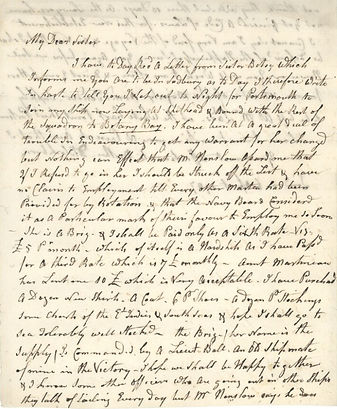
Letter from David Blackburn, April 6, 1787. Courtesy State Library of NSW.
Selected excerpts
July 12, 1788 - Sydney Cove Port Jackson, Norfolk Island, Aborigines, earthquake (Letter to Margaret)
"...It was the 19th before we arriv’d at Botany Bay, where we anchored at 4 in the afternoon, all in good health, & on the 21st the rest of the fleet arriv’d. The next day the Governor, Capt Hunter, the Master of the Sirius & myself went to examine a place where Capt Cook mention’d there was a Harbour to which he gave the name of Port Jackson. We found it an excellent & extensive one & on the 25th return’d to Botany Bay & conducted the whole fleet out of the harbour to the place where the convoy now stands. It is about 6 miles from the entrance. The Governor has nam’d it Sydney Cove..."
July 12, 1788 - First meeting with Aborigines at Botany Bay, the colony (Letter to Richard)
July 12, 1788 - Norfolk Island, Aborigines, earthquake (Letter to Margaret)
"...On January 19, at 4 in the afternoon we anchored (and all in good health and spirits) in the long-wished for
Botany Bay. The natives as we sailcd in came down to the edge of the cliffs, making a noise and lifting up their spears.
Immediately after anchoring the Governor, accompanied by some officers went on shore on the north side of the bay and met some of the natives on the beach. He went towards them singly, which as soon as they saw an old man walked from amongst them to meet him. This man (who probably remembered the dress of Captain Cook' officers) did not show the least sign of fear or distrust. The Governor put some red cloth round his neck, gave him some beads and other trifling presents with which he appeared well pleased. The natives, however, soon withdrew to the woods, and our party returned on board.
The next day we landed on different parts of the bay, saw the natives, who came to us without fear, armed with spears but without any appearance of hostile intention. They would receive anything from us, but we could not get them to eat or drink with us. I went to an elderly man, put a piece of blue cloth around his neck and a string of glass beads around his arm, shook him by the hand, which he seemed to take as a mark of confidence. I pulled a biscuit out of my pocket, broke it and gave him the other piece. He took it, put it in his mouth and appeared to be eating, and soon withdrew towards his companions. I followed him as a small distance, saw him throw down the bread, which I took up unseen by him, and found he had not tasted it....
...With respect to this country, I am really at a loss my friend. what to say. Tis true we know but little of it; but. I believe it is the general opinion that it will be a number of years before the mother country will derive any advantage from it adequate to the expense of maintaining a colony on it. The natives are to all appearances the lowest in rank among the human race. For my own part I believe the natives to be a quiet, inoffensive people. Yet I believe they are total strangers to personal fear, and have a quick sense of an injury.
The convicts, though they have experienced every indulgence from the Governor, whose humanity and attention to them whilst at sea and since our arrival hero entitled him to their esteem as their best friend, in general are a set of hardened wretches.
The tents were scarce set up before they began robbing them. The Governor began with them by trying (after sentence of death had been passed) what lenient measures would do, and altered their sentence to transportation to a small rocky island in the middle of the harbour, where they were fed on bread and water during pleasure. Blut this had no good effect, and it was soon found necessary to put the law in full force. Four have been hanged. Two more. were under sentence of banishment for life, but recieved a pardon on the King's birthday..."
"...In the beginning of Feby we took on board six months provisions with the necessary implements for settling a Colony on Norfolk Island, discovered by Capt Cook...
Our Gardens have produc’d nothing worth notice — nor I am afraid will not whilst we remain in the Colony which I hope will not exceed two years.
The Natives are black, they are quite naked & very dirty & have the appearance most miserable wretches. They live in caves & hollow places in the rocks & so far as we know have no other food but fish & fern roots. They almost always go armed with spears very long & barbed at the end with fish bone. We have never yet been able to persuade them to come into the Camp or on board the ships, though they frequently pass our Camp & come alongside the vessels, but would not come in, nor will they eat or drink with us nor taste any of our food. They seem to be a harmless inoffensive people...
They have killed a convict & wounded another who was in the woods collecting herbs but we have every reason to believe they were the aggressors. Indeed the convicts in general are the most abandoned wretches — four have been
hang’d for breaking into & robbing the Officers tents — we have never seen above 40 of the natives in a Body but once — on the 6th of June a Party of Gentlemen with their servants & 4 soldiers walking to Botany Bay met with a Body of 300 of them all arm’d with spears & targets. However they did not attempt to disturb our small Party.
On the 4th of June His Majesty’s Birth Day was kept here — the Sirius & Supply fir’d 21 Cannon each at Sun Rise & Noon & at Sun Set. All the Officers of the Navy & Army din’d with the Governor who then nam’d the Adjacent Country Round Port Jackson — the County of Cumberland.
On the 22nd of June at 20 Minutes after 4 o’clock in the afternoon a shock of an Earthquake was felt on Board the Ships & throughout the Camp our Surgeon & me at that time standing still & silent examining some Gum running from a large tree... "
November 15, 1788 - Aborigines. kangaroos, possums, dingoes, birds, sharks and fish. gardens, 'gold'
"...the country as far as we have been has a good soil but the land lies in continued tracts of swamps & rocky hills covered with a thin soil or a mixture of sand & black mould. Our gardens have produced little or nothing... I believe the Governor's is the only garden which has afforded a few vegetables for the table.
There is now some wheat & barley which promises to succeed... The valleys abound with cabbages trees with which most of these houses are built for the present. Several stone buildings are begun. The Governor’s house will be a very elegant one & is near finished.
I believe I told you in my last letter that the town will be called Albion. It is in the centre of the County of Cumberland. The trees of various kinds grow to a great size but when sawn into plank the wood is short and heavy and not fit for house or ship building.
...We have been now above nine months without being able to persuade the natives to live or associate amongst us or without being able to learn a sentence of their language. They seem to be the most miserable of the human race. They are quite naked and very dirty. Their principal food seems to be fish & fern roots. Many of the men are without the left tooth of the upper jaw and some of the females seem to have lost some of the joints of their little finger cut off.
Particular marks of Distinction are intended for I know not. They have Canoes of the most simple construction being nothing but the Bark of a tree about 12 feet long tied together at each end by a string of running vine which grows near the seaside. In one of these we have seen a Man, his Wife & Child go up and down the harbour striking fish with a spear, at which they are very dextrous.
They live in Caves & hollows of the rocks, with which the coast abounds, & sometimes they make a hut of the leaves of the cabbage tree, just big enough to sleep in. The men go armed with lancers, generally about 12 feet long pointed with a sharp fish bone, a very dangerous weapon, with which they will kill at 30 or 40 yards distance. They have clubs headed with stone & stone hatchets. They have also been very troublesome to our fishing & foraging parties, have wounded several & killed three so that we have been obliged to fire among them & are now always obliged to go well armed as they have several times come down in a body of 60 or so & thrown stones & spears at our people and even attempted to take fish from us.
They are great thieves & are very angry if prevented from taking what they have a mind to, & in all probability will always look upon us as enemies & take all advantages in their power.
There are several extraordinary animals in this Country. The Kanguroo is very curious. Some of them have been killed of 200 pounds weight & are very good eating...
Here are several smaller species of animals — the opossum — flying squirrels — dogs not unlike our fox dogs — some snakes which seem to be harmless — numberless ants — some very large which bite very severe. A beautiful variety of birds & of fishes... The sea abounds with whales of a great size & sharks the largest I have ever seen.
On the surface produces little of value to us so it is supposed the internal parts of this coast will afford us nothing worth digging for. A slate quarry is found but the slate is too brittle for use.
It is the opinion of many that iron may be found here & I am of the same opinion. But of the several metals I think none can be expected at least on this part of the coast. But of the purer metals, I think none can be expected, at least on this low part of the coast. However, an Artful fellow (a convict) formed means during the absence of the Governor (who was gone with a party inland) to raise a report that he had found a Gold mine. On which an officer & guard was sent to be conducted by him to the place but he gave them the slip - was soon after taken & confined till the Governor returned when after much equivocation & a good flogging he owned that he had filed a guinea & a brass buckle & mixed the filings up with a quantity of earth. The glittering particles were easily perceptible & when any lay fine of course naturally produced a little gold. He said he hoped by this scheme to get his freedom — and I am since informed that he now denys all that he said then & still says he knows where the place is but will not tell.
Since I wrote last we have been in the Supply to Norfolk Island with six months provisions for that Colony... I brought with me a small cargo of seals skins & small masts & some flax.
August 12, 1790 - Batavia - Crops. shortages and rationing, Batavia provisioning mission; Colony awaiting relief ships; Bennelong, Arabalanoo, Nanbarry, Abaroo
"...I believe I gave you but an indifferent idea of New South Wales. I can only now add, that it certainly is a very poor country, at least that part of it near the Colony is settled. The land is elevated & no having produced near so much as the least sanguine amongst us expected. Potatoes & garden stuff however do tolerably well & the first may in time become a substitute for bread.
The best that can be said of the Country is the healthiness of the climate & the excellent harbours it affords, at least so far as we have examined the coast. Our knowledge of it does not exceed 60 miles along the coast & about as much directly inland.
The number of acres cultivated is reckoned to be about beyond the gardens of the different officers. The Supply's garden contains 2 ½ acres & is as good as any. It affords a sufficient quantity of vegetables for the ship's company daily. The country produces nothing of itself which any European (not knowing the roots which the natives eat) can subsist on & the kangaroos which are excellent are now become very shy so that a constant supply of provisions & cloathing will be required for many years to come.
As to the natives we are almost as ignorant of their particular manners & customs if they have any as we were at first. They will not come among us though every method has been used to invite them.
We have had some taken by surprise. The first a man whose name was Arrabanoo lived with the Governor
& was very fond of him. He was of a meek disposition & seemed very contented but for want of understanding him
little was learned from him. He died in about 8 months. Another now lives with the Governor called Bennelong.
He is a merry fellow & does not seem inclined to go away — but no information can be got from him for the same reasons. He has some wounds. The Surgeon General has had a fine boy with him these two years called Nanbarry. He speaks pretty good English but is too young to give any information & it is probable will forget his native tongue as Mr Bennelong does not like to talk with him, or answer questions he is instructed to ask, & once struck him.
The Rev. Mr Johnston has a fine girl about 15 years called Abaroo, but little has yet been learned from her. She is very fond of Mrs Johnston...
The Sirius sailed from Port Jackson for the Cape of Good Hope Oct 1788 & arrived from thence May 8 1789, loaded with flour & the colony which now began to grow short of provisions of every species. However a supply from England was daily expected but the year 1790 ended without any arrival. The situation of the Colony became alarming, & in case the expected ships should not arrive, famine without the means of relief was apprehended. The colony was put on a short allowance. Such provisions as remained in store & in field. A council was held in which it was resolved that the principal part of the convicts, with a detachment of marines under the command of Major Ross the Lieutenant Governor, should with their portion of provisions go to Norfolk Island, with their portion of provisions and when this service was performed the Sirius should be sent to China for another cargo of provisions. Accordingly in March 1790 the Sirius & Supply sailed for Norfolk with about 500 convicts, men & women. On the 16th, 17th, 18th the people were all safely landed there, also the provisions from the Supply, but on the 19th the Sirius, in attempting to land more of the provisions, was unfortunately drove on shore by the violence of the sea & in ten minutes she was quite a wreck. She went on shore directly opposite the town & thank God no lives were lost. We stayed three days longer at this island, during which time the weather was too bad for any thing to get out of the Sirius. However I hope as it was fine weather a day or two after that most of the provisions was got from her. Otherwise their situation must be very bad. There is now near 600 people there.
On our arrival at Port Jackson we were ordered to proceed to Batavia as fast as possible for a supply of provisions.
The allowance of provision at this time was: Rice 1lb, Pease 1lb, Pork 2lbs, Flour 2lb a week to each person. The convicts were at a shorter allowance. All the boats were employed fishing the fish brought to the public square and there equally distributed.
...On 5th July we anchored in Botany Road. This city is the capital of the Dutch in the East Indies. Here we have loaded the Supply with Beef, Pork, Rice, Flour & Arrack. Also hired a Dutch ship of 350 Tons Burthen which is now taking in the like Cargo... We expect to sail from Port Jackson in about a Week..."
March 17, 1791 - Drought crisis, declining optimism about colony, Bennelong, Aborigines begin to assimilate
"...We sailed from Batavia on the 17 Aug 1790 & arrived at Port Jackson on the 19th October.. Mr Ball's health not permitting him to go to sea — the command of the Supply was given to me till his recovery... We found everything here (Norfolk Island) as we left it — except that they had suffered by a great drought having had but two slight showers of rain for five months. I believe every one here is perfectly confirmed in the opinion that this country can never be of any use to the mother country.
...Several of the natives came into the town in a friendly manner. They were well treated a house of brick was run up for a chief called Bennelong, where his wife, children & relations often come & stay a day or two.
Since then many more men, women & children are come among us, & are sometimes quite familiar — at other times so shy... They certainly have no king or supreme magistrate but seem to go in families or smaller tribes. The oldest man or most expert warrior of which tribe has great authority over the rest. They use their women as their menial servants & sometimes beat them very cruelly. Yet they are very jealous of them & never suffer them to be out of sight whilst among us. They often go out to meet other tribes & fight with them most desperately — the particular reasons for which we have not yet been able to ascertain. But among these people who make retaliation an invariable rule — the smallest affront on either side is sufficient to bring on a general battle..."